 blog
blog
Natural Upholstery Cleaning for Sensitive Skin
Table of Contents
- Why Natural Upholstery Cleaning Matters for Sensitive Skin
- DIY Non-Toxic Furniture Cleaner Recipes That Actually Work
- How to Remove Stains Naturally from Fabric Sofas
- Ingredients to Avoid for Sensitive Skin Protection
- Professional Upholstery Cleaning for Sensitive Skin
- What Makes a Cleaner Safe for Sensitive Skin
- Maintaining Your Upholstery Between Cleanings
- Frequently Asked Questions
Last Updated: October 6, 2026
Why Natural Upholstery Cleaning Matters for Sensitive Skin
Natural upholstery cleaning sensitive skin solutions protect both your furniture and your health. Traditional chemical cleaners can trigger irritation, rashes, or respiratory issues in people with reactive skin.
The numbers back this up. According to EWG's Guide to Healthy Cleaning, harsh chemicals in conventional cleaners can cause contact dermatitis and worsen indoor air quality. The global natural household cleaners market is projected to grow from $8.8 billion in 2026 to $20.99 billion by 2034, reflecting growing consumer demand for safer alternatives Fortune Business Insights natural household cleaners market analysis.
The real problem isn't just the active cleaning agents, but the residue left behind. Even after rinsing, chemical residues linger on fabric fibers and trigger delayed reactions; natural solutions break down into harmless compounds instead.
DIY Non-Toxic Furniture Cleaner Recipes That Actually Work
You don't need expensive products to clean upholstery safely. These pantry-staple recipes are fragrance-free and hypoallergenic, ideal for sensitive skin.
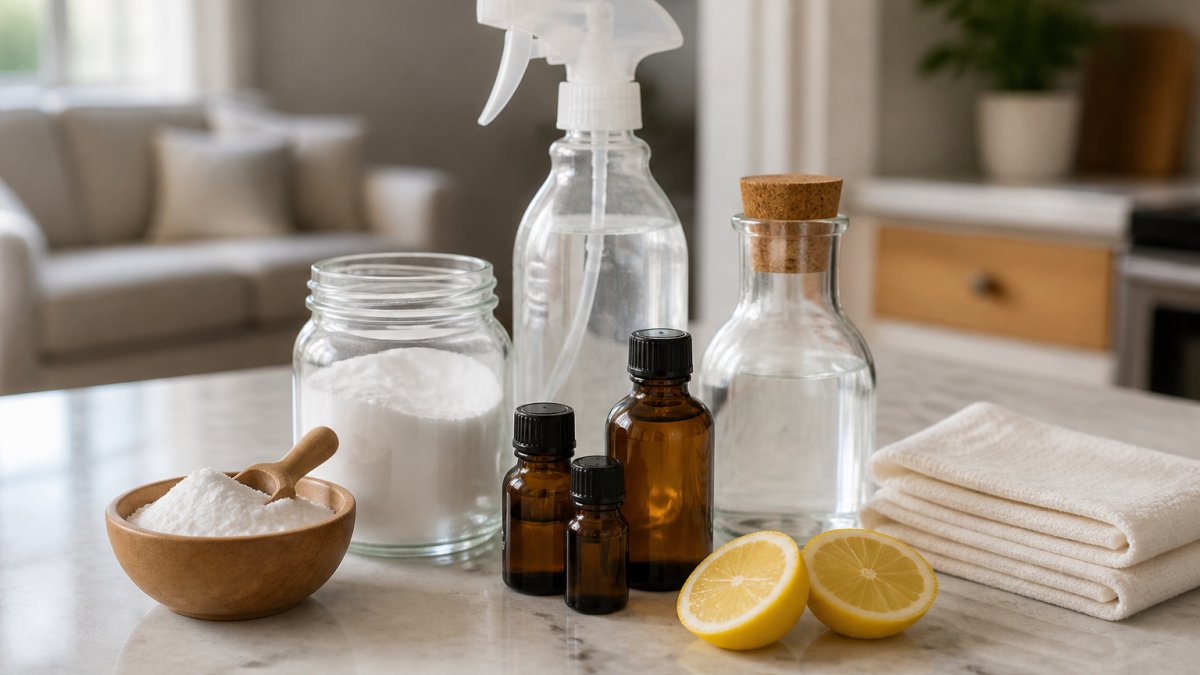
Baking Soda and Essential Oil Base
The gentlest routine-maintenance option, baking soda absorbs odors and lifts light dirt without residue.
What you need:
- 1 cup baking soda
- 10-15 drops of essential oil (lavender or lemon work best)
- Glass jar with shaker lid
Steps:
- Pour baking soda into the jar
- Add essential oil drops
- Seal and shake for 2 minutes
- Let sit for 24 hours to distribute scent
- Shake well before each use
- Sprinkle lightly on upholstery
- Wait 15 minutes, then vacuum thoroughly
Safe for all fabric types, it stays on top of the fibers and vacuums up.
White Vinegar Spot Treatment Solution
White vinegar cuts through stains while being non-toxic, pH-balanced, and fully evaporating with no residue.
What you need:
- 1 part distilled white vinegar
- 2 parts water
- Spray bottle
Steps:
- Mix vinegar and water in spray bottle
- Test on hidden fabric area first
- Spray lightly onto stain (don't soak)
- Blot with cloth immediately
- Repeat if needed
- Allow to air dry completely
The vinegar smell disappears within hours. It works on wine spills, pet accidents, and food stains.
Enzyme-Based Natural Cleaner
Enzyme-based cleaners break down organic matter naturally. Industry testing indicates that plant-based and enzyme-based upholstery cleaners now perform at levels that rival conventional chemical formulas for lifting deep stains Dr. Green Carpet upholstery cleaner performance analysis.
What you need:
- 1 tablespoon enzyme-based laundry powder
- 2 cups warm water
- Soft brush
Steps:
- Dissolve powder in warm water
- Let sit for 10 minutes
- Dip brush lightly in solution
- Work into stain in circular motions
- Wait 30 minutes
- Blot with damp towel
- Rinse with plain water
- Blot dry
Enzymes target protein and organic stains and are safe for sensitive skin because they break down completely during drying.
How to Remove Stains Naturally from Fabric Sofas
Stain removal requires strategy, the wrong approach can set stains permanently, damage fabric, or leave residue that irritates sensitive skin for weeks. Most guides stop at colorfastness testing, which only tells you whether the fabric will bleed, not whether the cleaner will trigger a skin reaction. The protocol below covers both.
Step 1: Identify Your Fabric Before Anything Else
Check the tag under the cushion or on the frame. The cleaning code tells you what the fabric tolerates:
- W, water-based cleaners only
- S, solvent-based cleaners only (natural water-based solutions can stain these)
- WS, water or solvent
If the tag is missing, test in a hidden area and treat the fabric as the most delicate type. Natural weaves like linen and cotton absorb more liquid and hold more residue than tight synthetics, so they need lighter application and more thorough rinsing.
Step 2: Run a Two-Part Patch Test
This is the step almost every guide skips: a colorfastness test protects the fabric, and a skin patch test protects you. Do both before a full application.
Fabric colorfastness test:
- Find a hidden area, underside of a cushion, back seam, or behind a skirt.
- Dampen a white cloth with your cleaning solution.
- Press gently for 10 seconds.
- Check the cloth for any dye transfer.
- Wait 24 hours and check the fabric for discoloration, ring marks, or fiber damage.
- Proceed only if the fabric looks unchanged.
Skin patch test (for the person with sensitive skin):
- Apply a small amount of the diluted solution to the inside of the forearm.
- Cover it with a bandage and leave it for 24 hours.
- Remove the bandage and check for redness, itching, or bumps.
- If there is any reaction, do not use that solution on upholstery the person will contact.
Reactions to natural cleaners are usually caused by essential oils or residue left on the fabric, not base ingredients like baking soda or diluted vinegar. If a patch test reacts, try the same recipe without essential oils first.
Step 3: Match the Method to the Stain and the Fabric
| Situation | Best Approach | Time Required | Drying Time |
|---|---|---|---|
| Fresh spill (within 1 hour) | Blot, then spot treat with diluted vinegar or enzyme solution | 10-15 minutes | 2-4 hours |
| Set-in stain (days or weeks old) | Enzyme-based cleaner with longer dwell time | 30-45 minutes | 4-8 hours |
| Odor without visible stain | Baking soda powder method | 15 minutes | 2-3 hours |
| Protein stain (pet, food, blood) on synthetic fabric | Enzyme cleaner, cool water | 30 minutes | 4-6 hours |
| Protein stain on wool or silk | Skip enzymes, use cool water and a pH-neutral soap | 15-20 minutes | 4-6 hours |
| Entire sofa needs refresh | Professional deep cleaning | N/A | 24-48 hours |
Step 4: Remove the Residue, The Step That Protects Sensitive Skin
This is the most overlooked part of natural upholstery cleaning sensitive skin, and it matters more than the cleaning itself. Natural soaps, vinegar, and even baking soda leave a film if not fully removed, that film attracts new dirt and sits against skin every time someone sits down.
After any wet cleaning:
- Rinse with a clean, barely damp cloth using plain water. Wring it out so it is not dripping.
- Blot, do not rub. Rubbing pushes residue deeper into the weave.
- Repeat the rinse-blot cycle until the cloth comes away clean with no soapy or slick feel.
- Dry thoroughly with a fan or open windows. Damp fabric is a residue trap and a mold risk.
- Vacuum once fully dry to lift any remaining powder or loosened film.
If the fabric still feels tacky or stiff after drying, residue remains; a second plain-water rinse usually resolves it.
Fabric-Specific Notes
- Linen and cotton: Use the lightest solution possible, rinse twice, and dry quickly. These fibers hold residue the longest.
- Polyester and microfiber: Residue releases easily, but microfiber attracts oils, skip any oil-based cleaner.
- Wool and silk: Use cool water and pH-neutral solutions only. Never use enzyme cleaners or anything alkaline.
Following this sequence, identify, patch test fabric and skin, match the method, then rinse thoroughly, removes the guesswork and residue that make natural cleaning risky for reactive skin.
Ingredients to Avoid for Sensitive Skin Protection
Some common cleaning ingredients trigger reactions in people with sensitive skin, but the risk profile changes depending on the surface. A chemical that rinses cleanly off a hard floor can cling to a porous linen weave for weeks. Understanding both the ingredient and the fabric it touches separates a safe clean from a reactive one.
The Short List of Ingredients to Avoid
Synthetic fragrances. Fragrance blends can contain dozens of undisclosed compounds and are a leading cause of contact dermatitis.
Quaternary ammonium compounds (quats). These antimicrobials appear in many commercial disinfectant sprays.
Phosphates and chlorine bleach. Harsh oxidizers that degrade fibers while producing irritating fumes.
Optical brighteners. These make fabrics look whiter but deposit residue that can transfer to skin.
How Fabric Type Changes the Risk
The same ingredient can be low-risk on one fabric and high-risk on another, because residue retention depends on fiber structure.
| Fabric Type | Residue Retention | Ingredients to Avoid Specifically |
|---|---|---|
| Linen and cotton (natural weaves) | High, porous fibers trap soap and oils | Heavy surfactants, oil-based conditioners, optical brighteners |
| Wool and silk (protein fibers) | Moderate, sensitive to pH | Alkaline cleaners, bleach, enzyme cleaners that digest protein |
| Polyester and nylon (synthetics) | Low, smooth fibers release residue | Solvent spot removers, high-heat steam |
| Microfiber | Low, but attracts oils | Oil-based cleaners, fabric softener-style additives |
| Rayon and viscose | High, weak when wet | Excess water, alkaline solutions, agitation |
A practical rule: the more porous and natural the weave, the more you should favor plain water, diluted vinegar, and baking soda over anything with added surfactants or oils. On wool and silk, skip enzyme cleaners entirely, the enzymes that break down protein stains will also attack the protein fiber itself.
Validate "Natural" Claims Before You Trust Them
"Natural" is not a regulated term on cleaning product labels. A product can call itself natural while still containing synthetic fragrance or preservatives. Two habits cut through the marketing:
- Read the full ingredient list, not the front label. If a product lists "fragrance" or "parfum" without specifying the source, treat it as a potential irritant regardless of the natural branding.
- Cross-check ingredients against a public safety database. EWG's Guide to Healthy Cleaning rates cleaning products and individual ingredients on hazard concerns including skin irritation, respiratory effects, and developmental toxicity. Searching an ingredient there takes under a minute and gives you a third-party read that a manufacturer's marketing copy will not.
For consumers with sensitive skin, baking soda remains a recognized natural cleaning agent that is gentle on skin and effective for various household surfaces, including upholstery maintenance Spekless natural home cleaning guide.
A Quick Screening Routine
Before any new cleaner touches your upholstery, run this three-step check:
- Scan for the six ingredients above. If any appear, look for an alternative.
- Confirm the fabric type from the furniture tag (W, S, WS, or X codes) and match it against the table above.
- Check the ingredient against a public hazard database before you buy, not after.
This routine takes a few minutes and eliminates most of the guesswork that makes "natural" cleaning feel risky for sensitive skin.
Professional Upholstery Cleaning for Sensitive Skin
Sometimes DIY methods aren't enough. Professional cleaning reaches deep into fabric fibers and removes allergens that surface cleaning misses, so look for specific certifications and methods.
Low-Residue and Residue-Free Methods
Professional cleaners using low-residue methods apply minimal moisture and extract it quickly. Residue-free cleaning uses specialized solutions that don't require rinsing.
These methods matter for sensitive skin because any leftover cleaning solution can irritate skin during contact. Professional equipment extracts moisture more thoroughly than household methods, reducing drying time and residue risk.
Sanctified Carpet & Upholstery Cleaning specializes in expert upholstery detailing, combining thorough cleaning with rapid drying.
Allergen and Dust Mite Removal
Professional equipment can extract dust mites, pet dander, and mold spores that hide deep in upholstery.
Research shows that professional cleaning using specialized equipment removed an average of 98.1% of common household allergens from upholstery and carpets Chem-Dry Home Health Study.
For families with allergies or asthma, professional cleaning every 6-12 months significantly improves indoor air quality, paying off through fewer symptoms and better sleep.
What Makes a Cleaner Safe for Sensitive Skin
Safety for sensitive skin depends on specific product qualities.
Hypoallergenic formulation, Products tested to minimize allergic reactions.
Dermatologist-tested, Independent skin testing confirms safety for reactive skin.
Non-toxic ingredients, Every component should be safe if it contacts skin.
Fragrance-free, No added scents means no fragrance allergens.
No volatile organic compounds, VOC-free products don't off-gas harmful chemicals.
Maintaining Your Upholstery Between Cleanings
Regular maintenance extends the life of your furniture and prevents stain buildup.
Weekly care:
- Vacuum with upholstery attachment to remove dust
- Fluff and rotate cushions
- Blot spills immediately with dry cloth
Monthly care:
- Apply baking soda powder and vacuum
- Check for new stains
- Wipe down wooden frames
Quarterly care:
- Deep clean with enzyme solution
- Address any set-in stains
- Refresh with baking soda treatment
Consistent maintenance prevents allergen buildup and catches stains early when they're easier to remove.
Protecting your family's health starts with the products you bring into your home.
Sanctified Carpet & Upholstery Cleaning offers professional upholstery detailing designed with sensitive skin in mind. Our expert team uses methods that clean thoroughly while minimizing chemical residue.
Frequently Asked Questions
What is the best natural cleaner for upholstery with sensitive skin concerns?
The best natural upholstery cleaners combine hypoallergenic, fragrance-free ingredients like baking soda, white vinegar, and enzyme-based formulas. These avoid volatile organic compounds (VOCs) and harsh surfactants that trigger skin irritation or contact dermatitis. Look for products labeled dermatologist-tested or EWG Verified. For your specific situation, patch test any solution on a hidden fabric area first to ensure colorfastness and safety.
Are natural upholstery cleaners effective at removing allergens and dust mites?
Yes. Professional cleaning using enzyme-based and plant-derived cleaners removes an average of 98.1% of common household allergens from upholstery. Natural methods work by breaking down organic matter where dust mites and allergens live. For best results, combine spot treatment with deep cleaning every 6-12 months. Rinse-free or low-residue formulas prevent residue buildup that reattaches allergens.
How do I know if a cleaning product is safe for sensitive skin?
Check for fragrance-free labeling, absence of volatile organic compounds, and dermatologist testing certification. The Environmental Working Group (EWG) provides a database of products free of harsh chemicals and irritants. Avoid products with synthetic fragrances, bleach, ammonia, or phenol. Always perform a patch test on hidden upholstery before full application. If your skin reacts to the dried residue, the product isn't suitable for your household.
What natural ingredients work best for removing pet stains and odors safely?
Baking soda absorbs odors and is gentle on sensitive skin, while white vinegar breaks down organic matter from accidents. Enzyme-based cleaners specifically target pet urine proteins. For fresh stains, blot first, then apply your chosen solution. For set-in pet odors, sprinkle baking soda, let sit 12-24 hours, vacuum, then treat with vinegar solution. These methods are asthma-friendly and pet-safe, though always ensure thorough drying to prevent mildew.