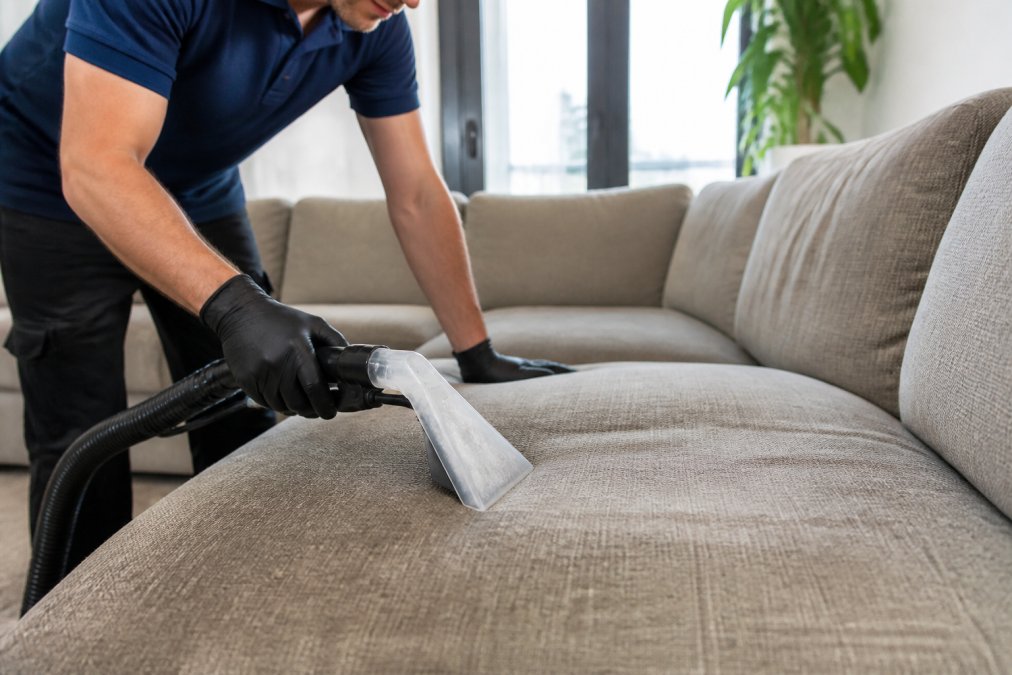
 ultimate-guide
What to Look for in a Reputable Upholstery Cleaning Company
Table of Contents
- Why Fabric Cleaning Codes Matter Before You Hire Anyone
- Questions to Ask Upholstery Cleaners Before Booking
- Upholstery Cleaning Methods Comparison: Steam, Dry, and Foam
- Certifications, Insurance, and What a Reputable Upholstery Cleaning Company Carries
- Red Flags: How to Spot a Bad Upholstery Cleaning Company
- Carpet and Upholstery Cleaning Bundle Deals: What to Know
- How Often Should You Get Upholstery Cleaned?
- Frequently Asked Questions
Last Updated: September 11, 2026
Why Fabric Cleaning Codes Matter Before You Hire Anyone
The fastest way to ruin a sofa is to let someone clean it without checking the tag first. Every piece of upholstered furniture carries a fabric cleaning code, and that single letter determines which methods are safe. Ignoring it is how "cheap" cleaning turns into permanent damage.
Here's what the codes mean:
- W and WS: water-based cleaners are safe. WS also tolerates mild solvents.
- S: solvent or dry-cleaning products only. Water can shrink, stain, or warp the fabric.
- X: vacuum only. No liquid cleaner of any kind.
A provider who doesn't ask about your code before quoting isn't being thorough. They're guessing. At Sanctified Carpet & Upholstery Cleaning, we treat the code as the starting point for every job.
The global carpet and upholstery cleaning services market is projected to reach $69.98 billion in 2026, growing at roughly 5.7% annually through 2034, according to Market Data Forecast's 2026 industry report. That growth is driven partly by homeowners who learned the hard way that fabric care is a specialty, not a commodity.
Questions to Ask Upholstery Cleaners Before Booking
A reputable upholstery cleaning company answers these without hesitation. If any answer feels evasive, keep looking.
- What cleaning code does my fabric have, and how does that change your method?
- Will you pre-inspect and spot-test before starting?
- Are you bonded and insured? Ask for proof, not a verbal yes.
- What equipment do you use? Truck-mounted steam extraction handles deep soil extraction better than portable units.
- How long will drying take? A professional setup should have furniture dry within hours, not days.
- What's your service guarantee if a stain returns?
- Can you share recent customer testimonials from my area?
Industry guidance for 2026 stresses vetting providers on experience with fine fabrics, customized methods, and safe cleaning solutions rather than price alone, per FiberSeal's upholstery service guidance. The questions above map directly to those criteria.
Upholstery Cleaning Methods Comparison: Steam, Dry, and Foam
Each method suits different fabrics, and the right choice depends on your cleaning code and soil level.
| Method | Best For | Dry Time | Watch Out For |
|---|---|---|---|
| Steam extraction | W/WS codes, deep soil | 4-8 hours | Over-wetting delicate weaves |
| Dry cleaning solvents | S codes, fine fabrics | 1-2 hours | Higher cost per piece |
| Foam/low-moisture | Light refresh, quick turnaround | 2-3 hours | Won't reach deep soil |
Steam extraction uses heated water and suction to lift embedded soil, making it the standard for deep cleaning on water-safe fabrics. Dry cleaning solvents protect textiles that water would damage. Low-moisture foam works for maintenance between deep cleans but won't fix pet accidents or set-in stains.
The mistake most homeowners make is choosing a method before knowing the fabric. Method follows code, always.
Certifications, Insurance, and What a Reputable Upholstery Cleaning Company Carries
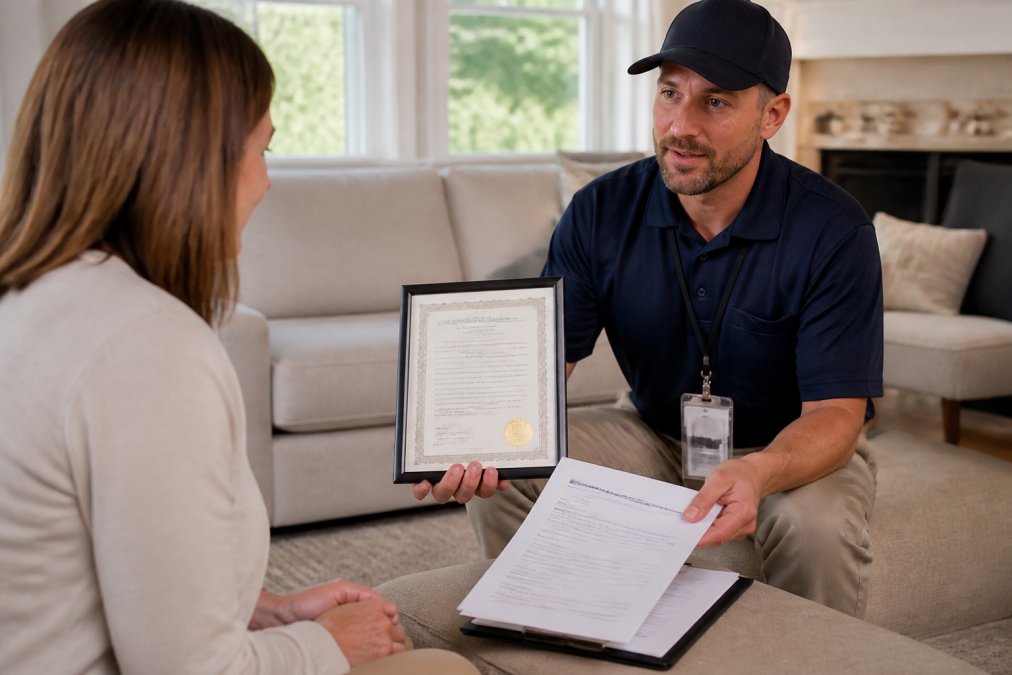
Certification and insurance separate professionals from opportunists, but only if you know how to verify them. A logo on a website proves nothing. Here is what to actually check.
Certification: What the IICRC Credential Means
The IICRC (Institute of Inspection, Cleaning and Restoration Certification) is the recognized standard-setting body for textile cleaning technicians. Its upholstery-specific designations, most commonly the Upholstery & Fabric Cleaning Technician (UFT) certification, require classroom training, a proctored exam, and continuing education to maintain (iicrc.org). That matters because upholstery fibers behave differently from carpet: a technician trained only on carpet may not know that a cellulose-based rayon will bleed when wetted, or that a jacquard weave can distort under agitation.
How to verify rather than trust:
- Ask for the technician's certification number, not just the company name. Certifications are issued to individuals, not businesses.
- Look the number up in the IICRC's public certified-technician directory.
- Ask when the certification was last renewed. IICRC credentials require continuing education every two years.
A company that says "all our techs are certified" but can't produce a number is telling you something. Most reputable firms keep certification cards in the truck and are happy to show them.
Insurance: Read the Certificate, Not the Sticker
"Fully insured" is a marketing phrase. What protects you is a certificate of insurance (COI) showing two specific coverages:
- General liability, covers damage to your property (the sofa, the rug, the hardwood underneath if water wicks through).
- Workers' compensation, covers the technician if they're injured in your home. Without it, an injured worker can pursue a claim against your homeowner's policy.
When you receive the COI, check three things: the policy effective dates (an expired certificate is worthless), the named insured (it should match the company you hired, not a parent LLC you've never heard of), and the limits of liability. A $1 million general liability limit is a common industry baseline; anything dramatically lower deserves a question.
You can also ask the company to have their insurer issue a COI naming you as certificate holder, reputable firms do this routinely for commercial clients and won't balk at a residential request.
Bonding: What It Actually Covers
A surety bond is not insurance. It's a guarantee that pays out if the company commits theft or fraud, for example, if a technician steals from your home. Bonding is most relevant for companies whose employees enter your home unsupervised. Ask whether the bond is a dishonesty bond (covers theft by employees) or a performance bond (covers failure to complete contracted work); they protect against different things.
The Documentation Test
A reputable company can produce, within minutes of your request:
- IICRC certification number(s) for the technician(s) assigned to your job
- A current certificate of insurance with effective dates and limits visible
- A written estimate and service guarantee on company letterhead
- A physical business address and state business registration you can look up
If any of these take "a few days to track down," treat that as a signal. Legitimate operators keep this paperwork accessible because they're asked for it constantly.
A company that can't produce documentation in minutes isn't one to trust with a $3,000 sectional, or with the wool rug your grandmother left you.
Red Flags: How to Spot a Bad Upholstery Cleaning Company
Warning signs show up before the truck arrives. The most damaging pattern in this industry is bait-and-switch pricing, a low advertised rate that balloons once the technician is inside your home and your furniture is already wet. Understanding how the tactic works is the best defense.
How Bait-and-Switch Actually Works
The playbook is consistent:
- The teaser quote. A phone or online quote of "$99 for three rooms" or "$49 per sofa", far below what the labor, chemicals, and equipment actually cost to deliver.
- The on-site upgrade. The technician arrives, inspects the furniture, and announces that your fabric requires a "deep-clean treatment," a "special solvent," or a "pet enzyme add-on" that wasn't in the original quote. The price triples.
- The pressure close. You're told the discount only applies today, the truck is already set up, or the chemicals are already mixed. Saying no feels like wasting the visit.
- The upsell ladder. Once you've agreed to the new price, additional line items appear, stain guard, deodorizer, mildew treatment, each framed as necessary to protect the work you just paid for.
A legitimate company quotes based on the fabric code, soil level, and square footage, and the price you're quoted is the price you pay. If the on-site number differs from the phone number, that's the tell.
Red Flags to Watch For Before Booking
- Quotes given over the phone without asking about your fabric code. A real quote requires knowing whether the upholstery is W, WS, S, or X.
- No physical business address. A PO box or a cell number with no street address makes it hard to pursue recourse.
- Cash-only payment with no receipt. This is designed to leave you without proof of the transaction.
- No written estimate. Verbal pricing is unenforceable. Reputable firms email or text a written quote before the visit.
- "Today only" discounts. Urgency is a pressure tactic, not a business model.
- No mention of spot-testing or pre-inspection. Every legitimate technician spot-tests an inconspicuous area before applying any product to the visible surface.
- Unmarked vehicles and no uniform or ID. Not conclusive on its own, but combined with the above, it's a pattern.
- Reviews that are all five stars and posted in a single week. Look for reviews spread over months, with at least a few that describe specific problems and how the company resolved them.
Red Flags During the Visit
- The technician refuses to let you see the chemicals being used or the labels on the bottles.
- They start work before you've signed a written estimate.
- They ask you to leave the room or step outside "so you don't breathe the fumes."
- They quote a new price after the furniture is already wet.
- They can't explain what cleaning method they're using or why it suits your fabric code.
What to Do If It Happens
If a technician pressures you mid-job, you are allowed to stop the work. Ask them to leave, document what was done with photos and timestamps, and do not pay for services you didn't authorize in writing. Keep any texts, emails, or voicemails, they're evidence if you need to dispute a charge with your card issuer or file a complaint with your state's consumer protection office or attorney general.
The One-Question Test
Before you book, ask: "Can you email me a written quote based on my fabric code, and is that the final price?" A reputable company says yes without hesitation. A bait-and-switch operator will find a reason to keep the number off paper.
Carpet and Upholstery Cleaning Bundle Deals: What to Know
Bundle deals save money when they're structured honestly. Combining carpet and upholstery cleaning in one visit cuts travel and setup costs, and reputable companies pass some of that savings to you. The key is knowing what's included.
A fair bundle should specify:
- Which rooms or pieces are covered
- Whether stain treatment and odor neutralization are included or extra
- Total price before any add-ons
- Any conditions, like minimum room counts
Ask for an itemized quote, not a lump sum. That way you can compare apples to apples and spot hidden fees before they appear on the invoice. Sanctified Carpet & Upholstery Cleaning offers bundle deals.
How Often Should You Get Upholstery Cleaned?
Most households should schedule professional upholstery cleaning every 12 to 18 months. Homes with pets, young children, or allergy sufferers benefit from cleaning every 6 to 12 months.
Between professional visits, vacuum upholstery weekly and treat spills immediately. Regular maintenance extends upholstery longevity and keeps fiber integrity intact, which delays replacement. For pet owners, professional odor neutralization reaches the padding where DIY products can't, which is why the smell returns when amateurs try to handle it alone.
Frequently Asked Questions
What certifications should a professional upholstery cleaner have?
Look for IICRC certification, which shows the technician completed training in fabric care and cleaning methods. IICRC-certified pros understand fiber integrity, pH-balanced solutions, and how to match methods to fabric cleaning codes like WS, S, and X. Ask to see the certificate and confirm it covers upholstery, not just carpet. Certification alone does not guarantee quality, but it separates trained technicians from operators who learned on the job.
How do I know if an upholstery cleaning company is trustworthy?
Check three things: proof of bonding and insurance, verifiable customer testimonials from the past six months, and a written service guarantee. A trustworthy company will also perform a pre-inspection and spot testing on a hidden area before treating the whole piece. If a provider cannot show insurance or refuses to put terms in writing, walk away. The carpet and upholstery cleaning services market is projected to reach $83.5 billion by 2030 (Grand View Research, 2026), so plenty of legitimate options exist.
How often should you get upholstery cleaned?
Most households should schedule professional upholstery cleaning every 12 to 18 months. Homes with pets, young children, or allergy sufferers benefit from cleaning every 6 to 12 months. If someone in the home has asthma or seasonal allergies, more frequent cleaning helps remove dust and allergens that settle into fabric. Between visits, vacuum upholstery weekly and treat spills immediately to extend the time between deep cleans.
What should be included in an upholstery cleaning quote?
A complete quote lists the number of pieces, the cleaning method for each fabric type, pre-treatment for stains, odor neutralization if needed, and any fabric protection application. It should also state the total price with no add-on fees for standard work. Ask whether the quote includes moving cushions, drying time estimates, and a satisfaction guarantee. If the provider will not itemize, request a written breakdown before you book.
Are carpet and upholstery cleaning bundle deals worth it?
Bundles usually save money because the technician is already on site with equipment set up, which reduces travel and setup costs. The savings depend on how many rooms and pieces you include. Sanctified Carpet & Upholstery Cleaning offers bundle deals for Toms River and Ocean County residents; contact them for current pricing.
What is the difference between steam extraction and dry cleaning for upholstery?
Steam extraction, also called hot water extraction, injects heated water and cleaning solution into the fabric, then vacuums it out with strong suction. It works well on most synthetic fabrics and removes deep soil. Dry cleaning uses solvent-based products with very little moisture, which suits delicate fabrics like silk, velvet, or anything coded S. The right method depends on your furniture's cleaning code, so a reputable technician will check the tag before recommending one.
Finding a cleaner you can trust comes down to verification: fabric codes, certifications, insurance, and straight answers. Sanctified Carpet & Upholstery Cleaning offers expert upholstery detailing and professional carpet cleaning with very reasonable prices and bundle deals built for local budgets. Get started with Sanctified Carpet & Upholstery Cleaning and refresh your home with cleaning done right the first time.