 how-to
Preventing Mold Growth in Wet Carpets: A 2026 Guide
Table of Contents
- How Long Does It Take for Mold to Grow on Wet Carpet?
- Step 1: Stop the Water Source and Assess the Damage
- Step 2: Extract Standing Water and Start Structural Drying
- Best Tools for Drying Wet Carpet and Controlling Humidity
- Signs of Mold Under Carpet Padding and Subfloor Damage
- Antimicrobial Treatments, Disinfectants, and Indoor Air Quality
- Preventing Mold Growth in Wet Carpets: Common Mistakes to Avoid
- Frequently Asked Questions
Last Updated: September 17, 2026
How Long Does It Take for Mold to Grow on Wet Carpet?
Mold can start growing on a wet carpet in as little as 24 to 48 hours. That window is short, and it is the single most important fact in this guide. According to RubyHome's mold statistics and prevention guidelines, wet areas must be dried thoroughly within 24 to 48 hours to prevent mold growth.
Step 1: Stop the Water Source and Assess the Damage
Stop the water at its source before you touch a towel. Every minute of flow makes the job bigger.
Start here:
- Shut off the supply valve or call a plumber for burst pipes.
- Kill power to any outlets near the wet area at the breaker.
- Photograph the damage for your insurance claim.
- Find the water source. Clean supply-line water is different from sewage backup.
- Check how far the moisture spread with a moisture meter.
Step 2: Extract Standing Water and Start Structural Drying
Extract standing water with a wet-dry vacuum before running any fans. Airflow over a soaked carpet just moves moisture around.
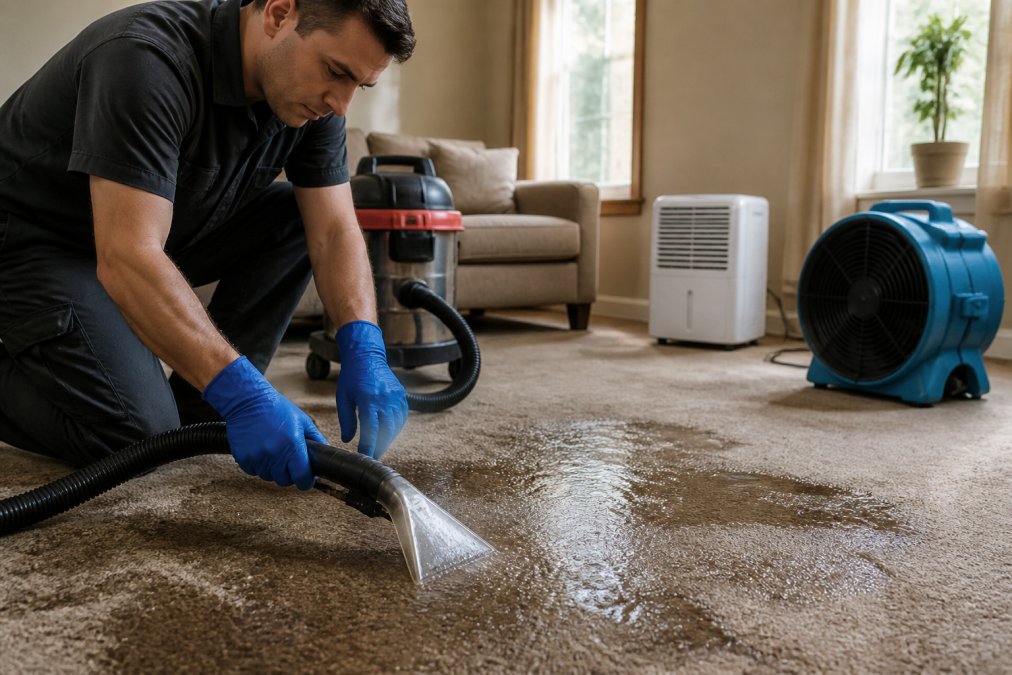
- Extraction. A wet-dry vacuum or professional extractor pulls bulk water out of the fibers.
- Air movement. Air movers lift moisture off the carpet surface so it can evaporate.
- Dehumidification. A dehumidifier pulls that moisture out of the air.
- Testing. A moisture meter confirms the pad and subfloor are dry.
Best Tools for Drying Wet Carpet and Controlling Humidity
The best tools for drying wet carpet are a wet-dry vacuum, air movers or box fans, and a dehumidifier. A moisture meter tells you when to stop. Here is what each tool does and where to get it:
| Tool | Job | Where to Get It | Rental Note |
|---|---|---|---|
| Wet-dry vacuum | Pulls standing water | Home improvement store | Cheap daily rental |
| Air movers | Lift surface moisture | Equipment rental yard | Faster than box fans |
| Dehumidifier | Removes airborne moisture | Retail or rental | Size to the room |
| Moisture meter | Confirms dryness | Retail | Buy, do not rent |
| Hygrometer | Tracks relative humidity | Retail | Under $20 |
When to Replace Carpet Padding Instead of Drying It
Replace saturated carpet padding rather than drying it. Pad is a sponge, once soaked through, it rarely dries fully in place.
Replace the pad when:
- It squishes or releases water when pressed
- It has been wet longer than 48 hours
- The water was dirty or came from a sewage source
- A musty odor has already started
Signs of Mold Under Carpet Padding and Subfloor Damage
A musty odor is the first sign of mold under carpet. You often smell it before you see it, but smell alone will not tell you whether it is surface mildew or something growing into the structure beneath your feet.
Watch for these signals:
- A persistent musty odor that returns after cleaning
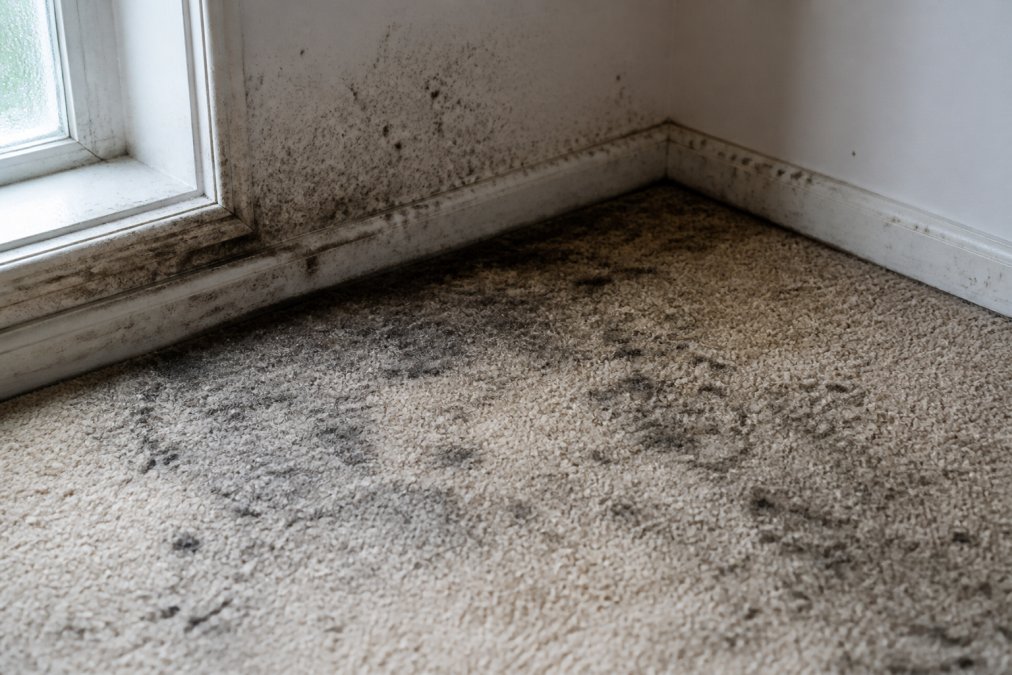
- Dark spots along the carpet backing or edges
- Visible mildew or fungal growth at the baseboards
- Soft, spongy, or warped subfloor boards
- Rising allergy symptoms in the household
- A carpet that feels damp in one spot days after the rest has dried
Mildew vs. Toxic Mold: How to Tell Them Apart
Most homeowners cannot tell mildew from mold by looking, and that is fine, the practical difference is location and spread, not color.
- Mildew is a surface growth: a flat, powdery patch, often white, gray, or yellowish, that wipes away with a cleaner and stays on the carpet surface or the face of the pad.
- Mold grows into the material. It looks fuzzy or raised, often dark green, black, or blue, and it returns after cleaning because the roots are still in the backing, pad, or subfloor.
How to Inspect the Subfloor (Concrete vs. Wood)
Subfloor inspection is the step most homeowners skip, and it decides whether you have a carpet problem or a structural one.
If the subfloor is wood (plywood or OSB):
- Press a screwdriver tip into the wood. If it sinks in easily or crumbles, the wood has begun to decay and needs to be replaced, not dried.
- Look for dark staining, a white or gray powdery film, or black streaks between boards.
- Check for swelling or delamination at the seams, lifted or separated plywood edges will not flatten back out.
- Probe along the baseboard and into the wall cavity. Water wicks sideways and up, so the wall bottom plate is often wet when the floor is.
If the subfloor is concrete (slab):
- Concrete does not rot, but it holds moisture and feeds mold on the adhesive and pad above it.
- Look for a chalky white residue (efflorescence) or dark staining, which signals ongoing moisture migration through the slab.
- Tape a square of plastic sheeting to the slab for 24 hours. Condensation under the plastic means moisture is still moving through the concrete.
- A slab can read dry on the surface and still be wet an inch down, so a pin-type moisture meter beats touch.
Antimicrobial Treatments, Disinfectants, and Indoor Air Quality
Antimicrobial treatment and disinfectant sprays help, but they are not a substitute for drying. No spray kills mold on a wet surface or removes the moisture it needs to return.
Use them in this order:
- Dry the carpet fully first.
- Apply an antimicrobial treatment to the cleaned area.
- Use a disinfectant only on surfaces rated for it.
- Run a HEPA air purifier to catch airborne spores.
- Check humidity again a week later.
Protecting the People in the Room, Not Just the Carpet
Most guides treat this as a carpet problem. It is also an air problem, and the people breathing that air matter more than the fibers.
While the carpet is wet and during cleanup:
- Keep vulnerable people out of the room. The Environmental Protection Agency's mold guidance advises that people with asthma, allergies, or a weakened immune system avoid moldy areas entirely, since they are the most likely to react.
- Wear an N95 respirator, not a dust mask. A basic cloth or surgical mask does not filter mold spores. An N95 or P100 respirator does. Add goggles and gloves if you are pulling up wet pad.
- Ventilate while you work, then close up to dry. Open windows and run a fan to clear the air during removal, then shut the room and run the dehumidifier to actually dry it.
- Do not dry-vacuum moldy carpet. A standard vacuum blows spores back into the air. Use a wet-dry vacuum on wet material, and only vacuum dry material after it has been treated.
- Watch for symptoms after the job. A cough, congestion, headache, or irritated eyes that show up in the days after cleanup and fade when you leave the house is a sign that spores are still present.
Antimicrobials, Disinfectants, and What They Actually Do
These products are not interchangeable, and using the wrong one wastes money and time:
- Antimicrobial treatments inhibit future growth. They work best on a clean, dry surface as a final step.
- Disinfectants kill bacteria and some fungi on contact, but only on surfaces the product is rated for. Many are not meant for carpet fibers and can discolor or damage them.
- Mold inhibitors added to cleaning solutions can help slow regrowth, but they do not penetrate a soaked pad or subfloor.
Preventing Mold Growth in Wet Carpets: Common Mistakes to Avoid
The biggest mistake is waiting to see if the carpet dries on its own. It will not, not fast enough to beat the 24-hour clock.
Other mistakes we see:
- Running fans without extracting water first
- Skipping the dehumidifier and just opening windows on a humid day
- Drying the carpet but ignoring the pad and subfloor
- Using a disinfectant spray on a still-wet carpet
- Assuming a musty smell will fade on its own
Frequently Asked Questions
What can I put on wet carpet to prevent mold?
The most effective approach is mechanical: extract standing water with a wet-dry vacuum, then run fans and a dehumidifier to dry the carpet within 24 to 48 hours. The EPA states that mold spores cannot grow without moisture, so removing the water is the priority. After drying, an antimicrobial treatment or disinfectant spray can address any remaining spores, but sprays alone will not stop mold if the carpet stays wet.
Will mold grow under wet carpet?
Yes. Carpet padding and the subfloor beneath it trap moisture and block airflow, creating ideal conditions for mold growth. The EPA confirms that indoor mold growth is controlled by managing moisture levels, and saturated padding is difficult to dry completely. If padding stays wet for more than 48 hours, replacement is often more effective than remediation because it cannot be fully sanitized.
How long can carpet be wet before mold starts growing?
Industry guidance sets the window at 24 to 48 hours. Wet areas must be dried thoroughly within that timeframe to prevent mold growth, according to RubyHome's 2026 mold statistics. After 48 hours, the risk rises sharply, especially in humid rooms or when the water source was a sewage backup. If you cannot dry the carpet within two days, call a professional.
Is it safe to keep carpet that has been flooded?
It depends on the water source. Clean water from a supply line or rain leak can sometimes be dried and saved if you act within 24 to 48 hours. Floodwater or sewage contamination introduces bacteria and pathogens that soak into carpet fibers and padding, and those materials should be removed and replaced. A moisture meter can confirm whether the carpet and subfloor have dried completely before you decide to keep them.