 ultimate-guide
Pet Odor Removal for Sensitive Noses: 2026 Guide
Table of Contents
- Why Pet Odors Hit Sensitive Noses Harder
- How to Remove Pet Urine Smell From Carpet Safely
- Choosing a Fragrance-Free Pet Odor Eliminator
- Air Purification and Ventilation for Indoor Air Quality
- Odor Mapping: Matching the Treatment to the Surface
- When to Call for Professional Pet Stain and Odor Removal
- Frequently Asked Questions
Last Updated: September 15, 2026
Why Pet Odors Hit Sensitive Noses Harder
Pet odor removal for sensitive noses starts with one uncomfortable fact: the smell you notice is not the smell your dog notices. A dog's sense of smell is 10,000 to 100,000 times more sensitive than a human's, according to NOVA's comparison of canine and human olfactory capabilities. That same biology explains why some people in a household react to lingering pet odors long after others stop noticing them.
Pet odor removal neutralizes odor-causing compounds at the source rather than covering them with scent. It matters most in homes where someone has asthma, allergies, or chemical sensitivity, because those residents absorb what standard cleaning leaves behind.
At Sanctified Carpet & Upholstery Cleaning, we get calls from pet owners who have shampooed a carpet four times and still smell urine when the humidity rises. The odor isn't gone. It's dormant.
The Difference Between Odor Molecules and Masking Agents
Odor molecules are volatile organic compounds that evaporate from urine, feces, and pet dander and travel through the air to your nose. Masking agents are fragrances that coat them with a stronger scent.
Here's the problem: masking doesn't remove anything. It adds a second odor layer on top of the first. For someone with respiratory sensitivity, that's often worse than the original smell. Harsh disinfectants like bleach can push pets into a state called "nose blindness," which creates stress when they can't process the scents around them, per Fear Free's guidance on how scent affects pets.
How to Remove Pet Urine Smell From Carpet Safely
Learning how to remove pet urine smell from carpet safely comes down to three moves: blot, neutralize, and dry. Skip one and the odor returns within weeks.
Urine soaks through carpet fibers into the backing and pad. Surface cleaning reaches the top layer only, which is why the smell reappears when humidity rises and reactivates the residue below.
Blotting, Enzymatic Cleaners, and What Actually Works
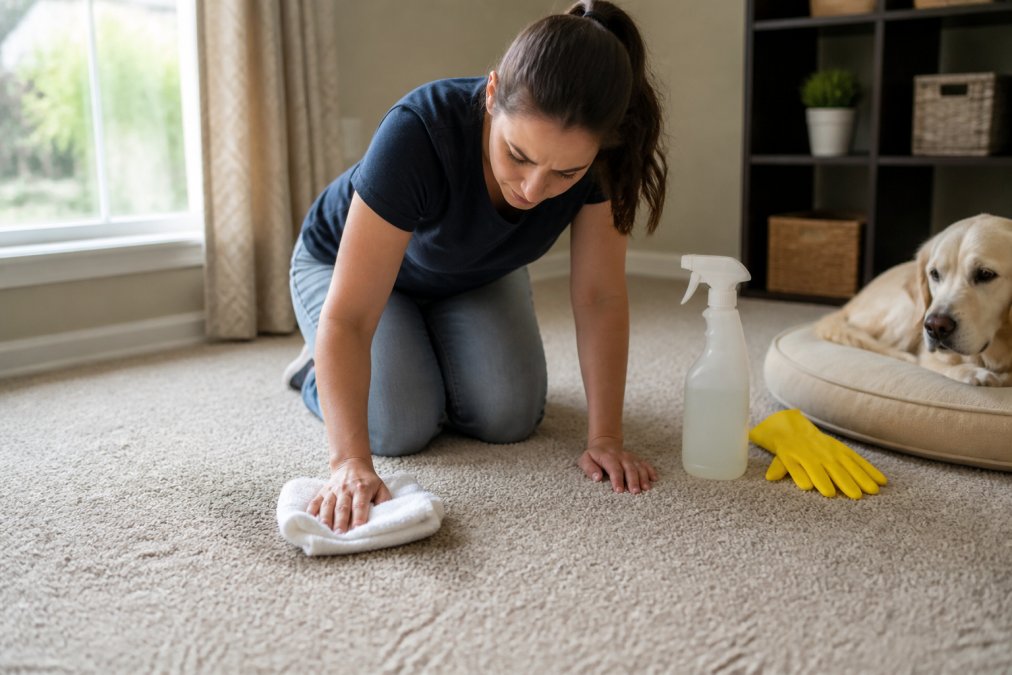
Blotting means pressing a clean cloth into the stain to lift liquid, never rubbing, which pushes urine deeper into the pad.
An enzymatic cleaner contains enzymes that break down the uric acid crystals in pet urine, actually eliminating the odor rather than covering it. Most household cleaners can't touch uric acid crystals, which is why they fail.
Work in this order:
- Blot the fresh accident immediately with a clean white cloth, pressing firmly
- Rinse the area with cool water and blot again
- Apply an enzymatic cleaner and let it sit for the full dwell time on the label
- Cover the spot with a dry towel and weigh it down overnight
- Vacuum once fully dry
A solution of one part white vinegar to three parts water rinses mild, fresh spots, and baking soda sprinkled over a damp area and vacuumed after drying absorbs surface residue. Neither reaches the pad.
Choosing a Fragrance-Free Pet Odor Eliminator
A fragrance-free pet odor eliminator suits any household with asthma, allergies, or a scent-sensitive pet. Look for "fragrance-free" on the label, not "unscented," which can still contain masking chemicals.
Market demand has shifted hard in this direction. Products that prioritize safety for sensitive noses and pets, rather than perfume, now dominate the fast-growing segment: the pet odor eliminator market is projected to reach $125.11 million by the end of 2026, up from $91.786 million in 2021, according to Cognitive Market Research's pet odor eliminator report.
| Product Type | How It Works | Best For | Watch Out For |
|---|---|---|---|
| Enzymatic cleaner | Breaks down uric acid crystals | Fresh and old urine stains | Dwell time required |
| Oxygen-based cleaner | Oxidizes organic residue | Set-in stains, color-safe | Weaker on ammonia |
| Vinegar solution | Mild acid neutralization | Fresh surface spots | Doesn't reach pad |
| Fragrance-free neutralizer | Chemically binds odor molecules | Sensitive noses, daily use | Verify "fragrance-free" label |
The label matters more than the marketing. "Pet-safe" is not a regulated term, so read the ingredient list and check for volatile organic compounds that off-gas into indoor air.
Air Purification and Ventilation for Indoor Air Quality
Air purification handles what surface cleaning cannot: airborne particles and odor gases that keep circulating after the stain is gone. It's the step most guides skip, and the one that decides whether a sensitive nose notices a difference, because a sensitive person reacts to what's suspended in the air, not just what's on the floor.
Odors often persist in the air or deep within fibers even after the visible source is cleaned, which is why secondary air filtration or professional intervention becomes necessary, per Topaz Veterinary Clinic's guidance on pet odor control.
What Each Filter Layer Actually Does
A HEPA filter traps pet dander and airborne particles down to 0.3 microns; an activated carbon layer absorbs the odor molecules themselves. You need both: HEPA alone catches particles but not gases, and carbon alone doesn't catch dander. A HEPA unit without carbon clears dander but leaves the ammonia and volatile organic compounds a sensitive nose picks up.
When shopping for a portable unit, match the clean air delivery rate to the room's square footage and run it continuously where the pet spends the most time, not just during cleaning sessions. A unit that runs only an hour after an accident never gets ahead of the continuous low-level release from bedding and carpet.
HVAC Filters, MERV Ratings, and Airflow
Your central system's filter is the other half of the equation.
Ventilation Timing That Actually Moves Air
A few specifics make the difference:
Odor Mapping: Matching the Treatment to the Surface
| Surface | Why Odor Hides There | Treatment Approach | Sensitive-Nose Watch-Outs |
|---|---|---|---|
| Carpet and pad | Uric acid crystals bind to backing and pad fibers | Enzymatic cleaner with full dwell time, then weighted dry towel overnight | Fragranced "pet" sprays leave masking residue that off-gasses for days |
| Hardwood | Urine seeps into seams and can stain or warp finish | Surface neutralization with pH-appropriate cleaner; do not saturate | Vinegar can dull some finishes; test on a hidden board first |
| Tile and grout | Grout is porous and holds residue in the joints | Enzyme soak on grout lines, then rinse and dry with airflow | Bleach on grout near urine releases chloramine vapors |
| Upholstery and cushions | Foam holds liquid and releases it slowly | Low-moisture extraction; avoid over-wetting so fabric doesn't wick | Wet foam grows odor-causing bacteria if it doesn't dry fully |
| Mattress and bedding | Body heat and humidity reactivate residue nightly | Wash covers hot; treat mattress surface with enzyme, then air-dry | Detergent fragrance lingers in pillows near the face all night |
| Baseboards and drywall | Urine splashes and wicks upward at the wall base | Wipe with enzyme solution, then seal if staining persists | Painted surfaces can absorb and re-release odor for months |
| Curtains and fabric blinds | Airborne odor molecules settle into fibers | Wash per care label or steam; avoid heavy fragrance sprays | Dry-cleaner solvent smell is a common migraine trigger |
When to Call for Professional Pet Stain and Odor Removal
Call a professional when:
Frequently Asked Questions
What is the most powerful pet odor eliminator for sensitive noses?
The most effective options for sensitive noses combine enzymatic cleaners that break down uric acid crystals with fragrance-free formulas. Look for products labeled non-toxic and hypoallergenic. A dog's sense of smell is 10,000 to 100,000 times more sensitive than a human's (NOVA PBS), so even trace residue matters. For persistent odors, professional pet odor removal using commercial-grade extraction reaches deep into carpet padding where household cleaners cannot.
Do air purifiers actually eliminate pet odors?
Air purifiers with HEPA and activated carbon filters reduce airborne pet dander and lingering odor molecules, but they do not clean the source. Research from Topaz Veterinary Clinic (2026) notes that odors often persist in fibers and air even after surface cleaning. Use an air purifier alongside deep cleaning, not instead of it, for better indoor air quality.
Are enzyme-based cleaners safe for people with chemical sensitivities?
Most enzyme-based cleaners are safe for chemical sensitivities when they are fragrance-free and free of volatile organic compounds. The enzymes are proteins that break down uric acid, bacteria, and odor molecules biologically rather than through harsh chemicals. Check labels for non-toxic and hypoallergenic claims, and test a small area first if you have known respiratory sensitivity.
How much does professional pet stain and odor removal cost?
Professional pet odor removal services average $350, with typical jobs ranging from $100 to $700, according to Eagle Restoration (2026). Severe cases involving subfloor saturation can reach $2,000. Pricing depends on the affected area, odor severity, and surface type. For a quote specific to your home, contact Sanctified Carpet & Upholstery Cleaning directly.
Pet odor that keeps returning isn't a cleaning failure on your part. It's a sign the odor reached a layer your equipment can't touch. Sanctified Carpet & Upholstery Cleaning brings professional carpet cleaning and expert upholstery detailing to pet owners who need the source gone, not masked, with very reasonable prices and bundle deals for multi-room jobs. Send a message to get a quote for your home.